
The QSP Ethnographic Study is a qualitative research approach focused on direct observation and in-depth understanding of real behaviors, practices and contexts in which consumers, users or audiences interact with products, services and brands.
Through an ethnographic methodology, QSP researchers adopt an insider perspective, placing themselves in the user’s position to understand motivations, needs, habits and decision-making processes within their natural environment. This close proximity to real-life contexts enables the capture of insights that rarely emerge through traditional declarative methods, revealing the “why” behind behavior.
Thanks to its versatility, ethnographic research can be applied across multiple contexts – from product and service usage and consumption, to the analysis of experiences, customer journeys, and physical or digital environments. Whenever relevant, the methodology may be complemented with technological tools, allowing qualitative insights to be combined with quantitative data and strengthening the robustness of the analysis.
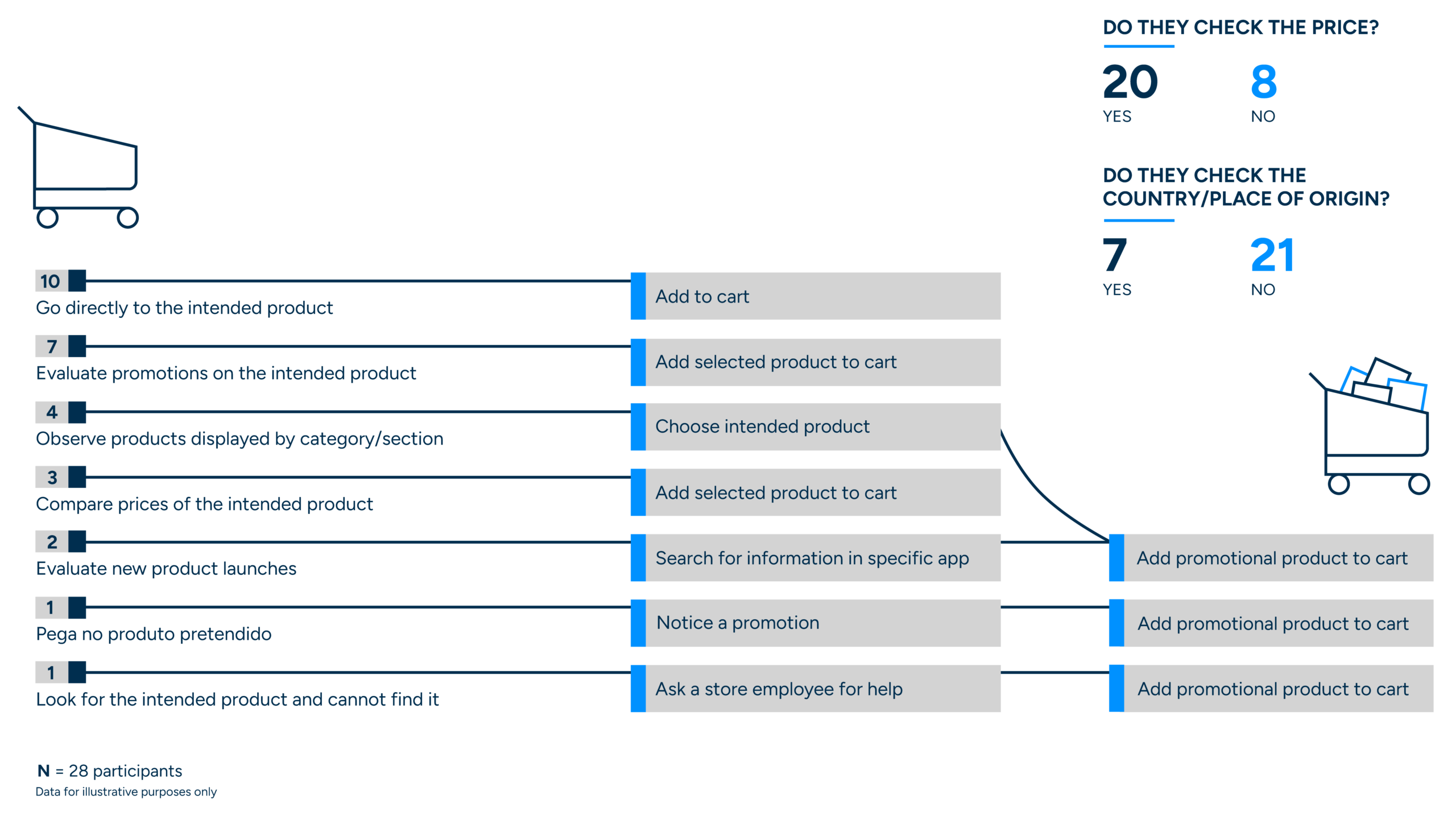
EXAMPLE OF ANETHNOGRAPHIC STUDY OUTPUT
The QSP Ethnographic Study is based on a systematic, rigorous and faithful documentation of reality, using a range of data collection techniques, including:
- Direct observation and field notes
- Observation diaries
- Unstructured or semi-structured interviews
- Mapping of spaces, contexts and interactions
- Photographic and video recording
- Audio recordings and document analysis
The final outcome is a set of deep, contextualized and actionable insights that help organizations better understand their audiences, design more relevant experiences and make informed decisions regarding product, service, communication and strategy.